
Checking Criminal History in Huntingdon County
Start with the record that answers the question. The Unified Judicial System of Pennsylvania Web Portal is the best first stop for a Huntingdon County criminal court history. Search the Magisterial District Court level as well as Common Pleas. A recent complaint can remain under an MJ number before a CP-31 file exists. Full name, a careful spelling check, filing year, and a known docket or police incident number help separate close matches.
The portal is an index and docket source, not a copy of every paper filed. Confirm the charge grade, case status, disposition, and sentence on the docket. Then ask the Clerk of Courts for an older, certified, or non-imaged part of the Huntingdon County criminal record. The official UJS search screen shows the statewide entry point.
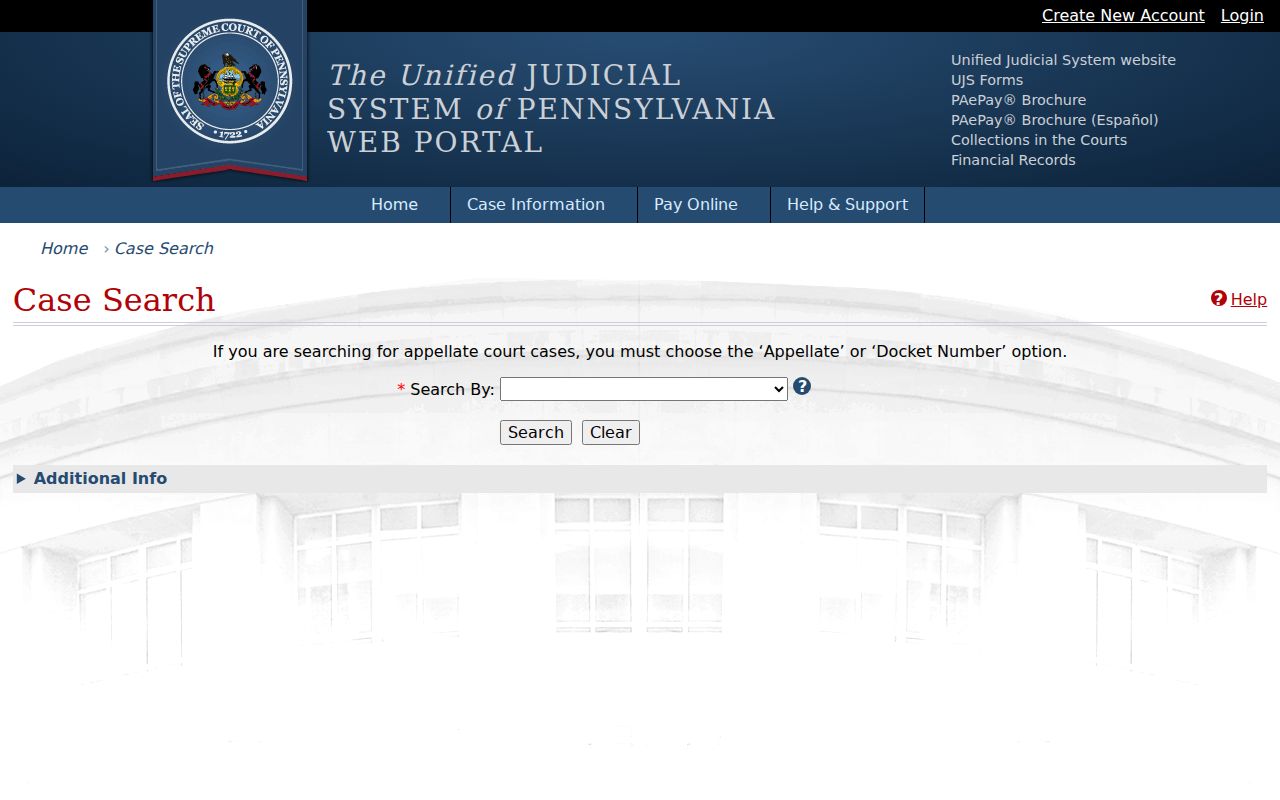
That screen can locate court events, but police reports, booking status, and the state repository response still come from separate custodians.
- Search Huntingdon County criminal dockets by name, docket, or incident number in UJS.
- Check the correct court level and compare identity details without assuming a same-name result belongs to one person.
- Read the filed charges, later amendments, final disposition, sentence, bail, and linked lower-court number.
- Call the police agency or county prison when the needed record concerns the event or present custody.
- Request a certified court copy or an official PSP repository response when that distinct product is required.
Huntingdon County Records: PATCH or UJS
PATCH and UJS do not search the same collection. Pennsylvania Access To Criminal History returns a name-based response from the Pennsylvania State Police Central Repository. UJS shows public court dockets. A court case may reach UJS before all fingerprint and disposition data reach PSP, while limited-access material may lawfully disappear from a public view. Use docket and offense tracking numbers to compare sources instead of treating a mismatch as proof that either system is wrong.
The PATCH transaction interface illustrates the repository route used for a Pennsylvania name check.
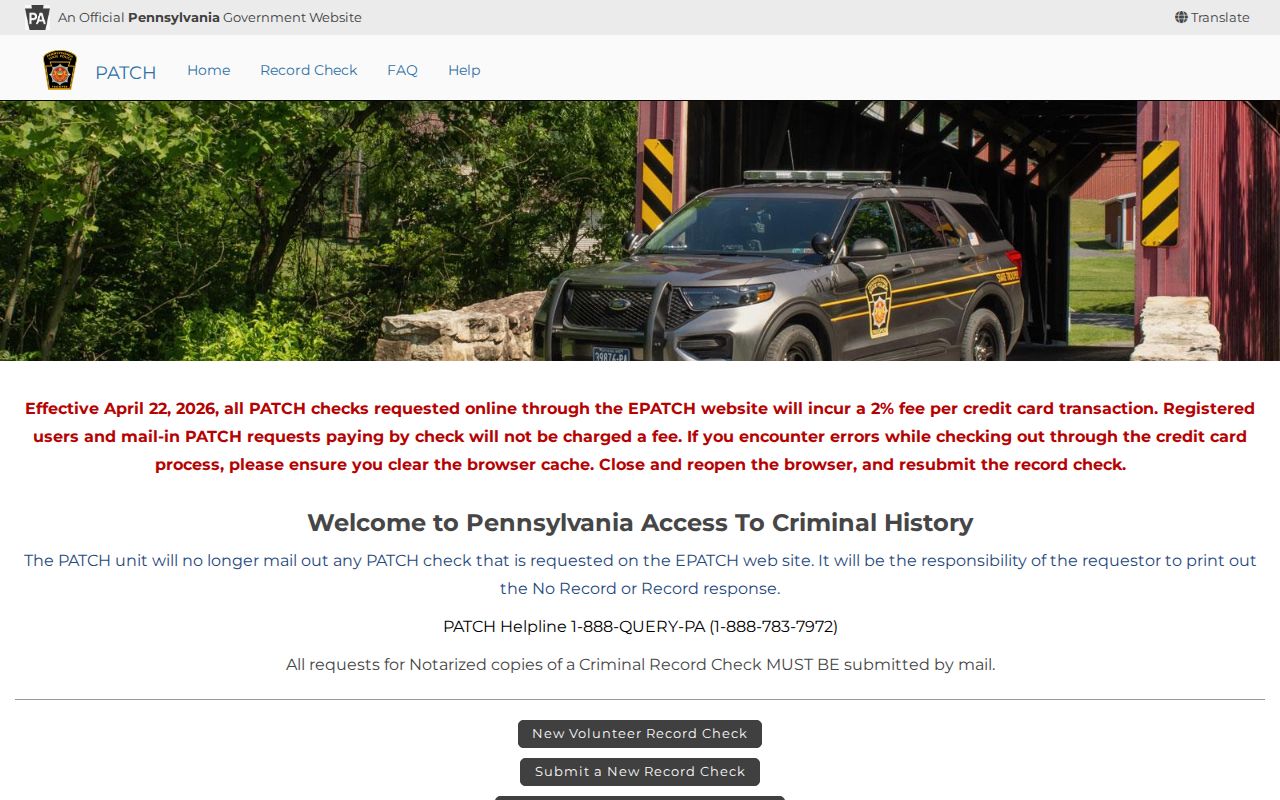
A PATCH result marked “Under Review” signals manual comparison of a possible match. It does not mean PSP found a record. The review may take two to four weeks and may resolve as either “No Record” or “Record.”
| Channel | Best Use | Important Limit |
|---|---|---|
| UJS Portal | Huntingdon County docket, events, charges, and outcome | Not every filed document is downloadable |
| PATCH | PSP statewide name-based repository response | Not a federal check or live custody search |
| Clerk counter | Certified, older, or non-imaged criminal case material | Court access rules apply |
| Police or prison | Incident report, booking file, or current local custody | Each office releases only records it holds |
Pennsylvania Official Background Checks
The Pennsylvania State Police Central Repository offers several official products. An ordinary PATCH name check costs $22. A notarized response costs $27, and a qualifying volunteer request is free. A person who wants the fuller review of their own repository file uses the mail-only SP 4-170 Individual Access and Review process, which costs $20. That subject-access product is not the same as a public PATCH certificate.
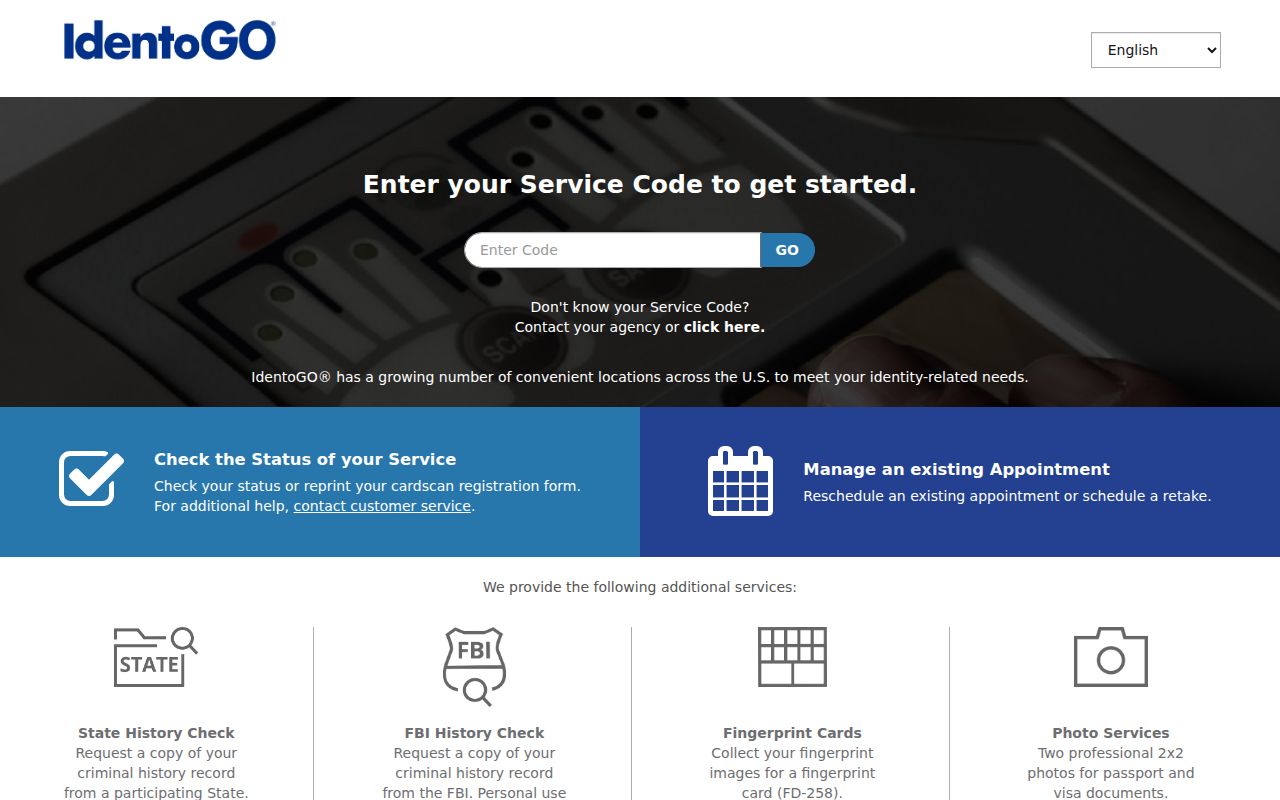
Some statutory programs require fingerprints through IdentoGO by IDEMIA. Enrollment begins with the program's service code, followed by identity details, a site and time, and approved identification. No official source confirmed a specific Huntingdon County enrollment location or a single general fee, so the sponsoring program's current instructions control.
The official IdentoGO enrollment site shows why the correct service code must come first.
Federal self-review is separate. A person may begin an FBI Identity History Summary through the Electronic Departmental Order system, pay the $18 FBI fee, and submit fingerprints through an accepted route.
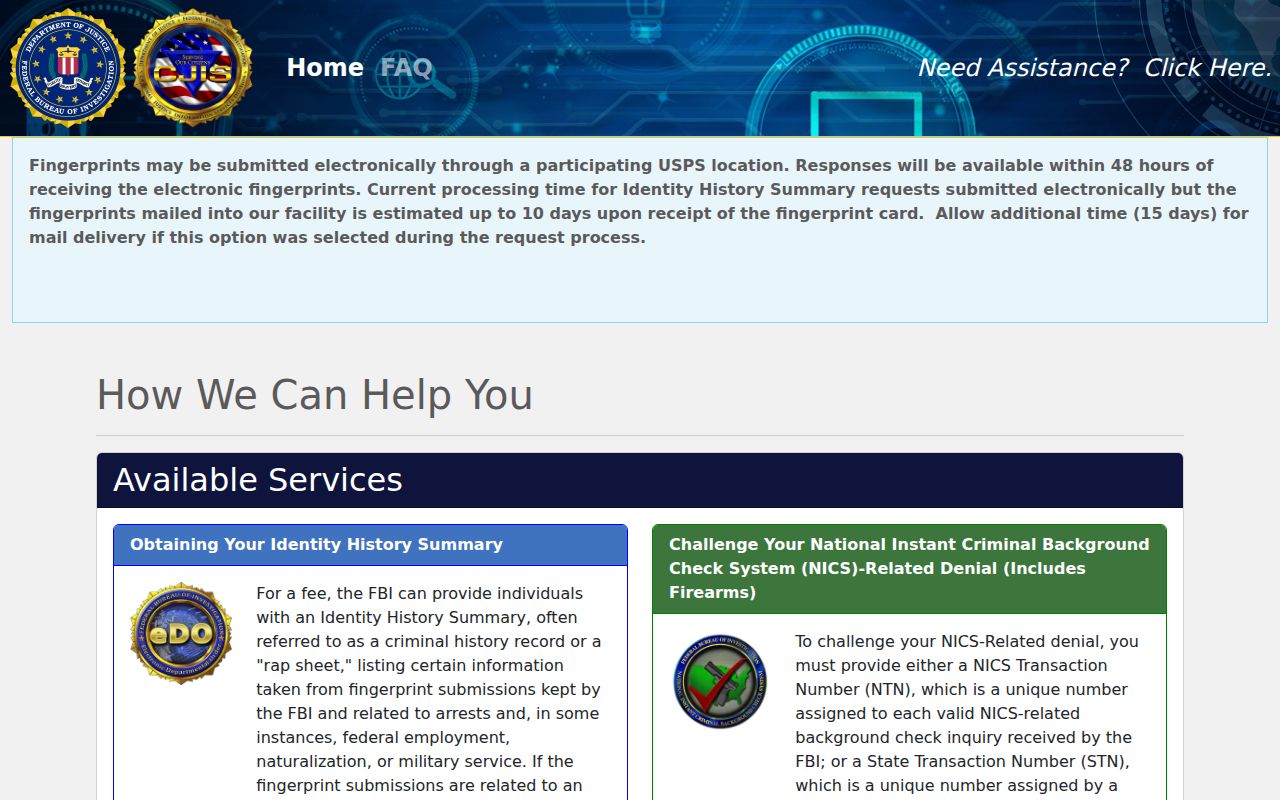
The FBI product covers federal identity-history data for the subject. PATCH remains the Pennsylvania repository channel.
| Official Product | Published Fee | Scope |
|---|---|---|
| PATCH ordinary check | $22 | Pennsylvania name-based repository response |
| PATCH notarized response | $27 | Ordinary response with notarization |
| SP 4-170 self-review | $20 | Mail-only access to the subject's fuller PSP record |
| FBI Identity History Summary | $18 direct FBI fee | Fingerprint-based subject-only federal history |
Four Huntingdon County Record Custodians
Huntingdon County criminal records are split by who created them. Borough police or PSP keep the incident narrative. Huntingdon County Prison keeps local intake and custody information. The MDJ office or Clerk of Courts keeps the docket and filed court record. PSP keeps the statewide repository cycle. The sheriff serves warrants and transports prisoners, but that role does not make the sheriff the owner of every police report or court file.
The county government directory is the official path to local departments and current contact pages.
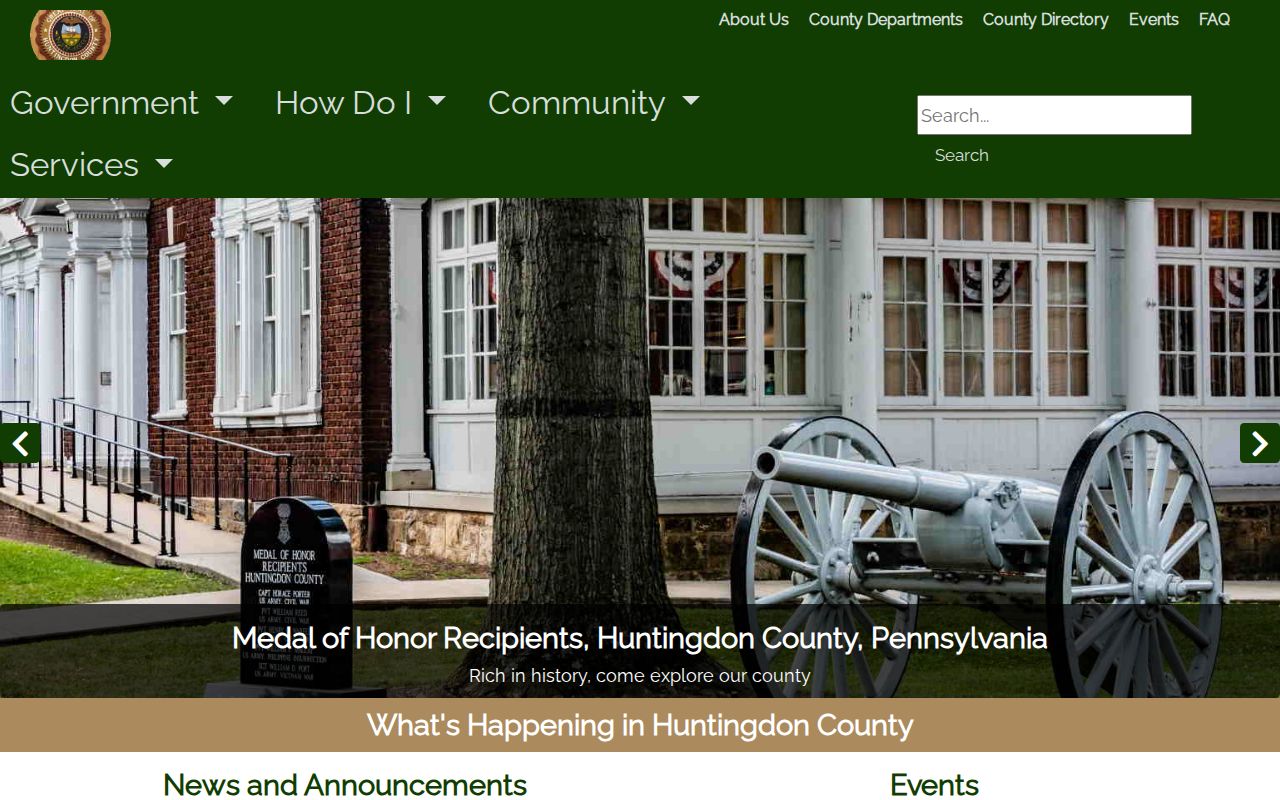
Ask which office possesses the exact record before filing a Right-to-Know request. An agency need not create a new compilation merely because related facts exist elsewhere.
Clerk of Courts
223 Penn Street, Huntingdon, PA 16652
814-643-1610
Criminal dockets, court files, and certification
County Sheriff
430 Penn Street, Huntingdon, PA 16652
814-643-0880
Warrant service and court process
County Prison
300 Church Street, Huntingdon, PA 16652
814-643-2490
Local custody and booking records
District Attorney
207 Washington Street, Huntingdon, PA 16652
814-643-5371
Prosecution files and a separate RTKL route
Criminal Record Types
A Huntingdon County criminal history can refer to several distinct records. Police incident and arrest reports describe an event and custody decision. The prison's booking file records intake and release. An MDJ docket covers the complaint, preliminary arraignment, bail, and preliminary hearing. A Common Pleas file follows formal charges held for court through motions, plea or trial, disposition, sentence, costs, and appeal activity.
PATCH is an identity-based repository response. A warrant is court process, and a Megan's Law profile is a statutory registry record rather than a general criminal report. PA DOC records describe state incarceration or parole, not a stay in the Huntingdon County Prison.
- Police and arrest records: held by the agency that investigated or made the arrest.
- Booking records: created by Huntingdon County Prison for local intake and custody.
- Court case files: kept by an MDJ or the Huntingdon County Clerk of Courts.
- Repository history: compiled by PSP from fingerprint and disposition reports.
- Custody and registry records: maintained under separate county, PA DOC, or Megan's Law systems.
For a closer look at allegations, intake, and release sources, use the Huntingdon County arrest lookup. A court outcome still requires the docket.
Huntingdon County Criminal Docket Codes
Three elected Magisterial District Judges handle preliminary and summary work across Huntingdon County. Their criminal files use MJ-20301, MJ-20302, or MJ-20304 identifiers. Local Rule 131(B) then centralizes most criminal proceedings after preliminary arraignment in Central Court, numbered 20-0-00, where the MDJs rotate. Central Court is a shared proceeding, not a fourth public walk-in district office.
A felony or misdemeanor held for court moves to a Common Pleas number written as CP-31-CR-sequence-year. The “31” is Huntingdon County's code. One prosecution can therefore leave an issuing-district docket, a Central Court event, and a later CP-31 record. Search both levels and use the linked docket information.
The 20th Judicial District website provides local court administration and notices.
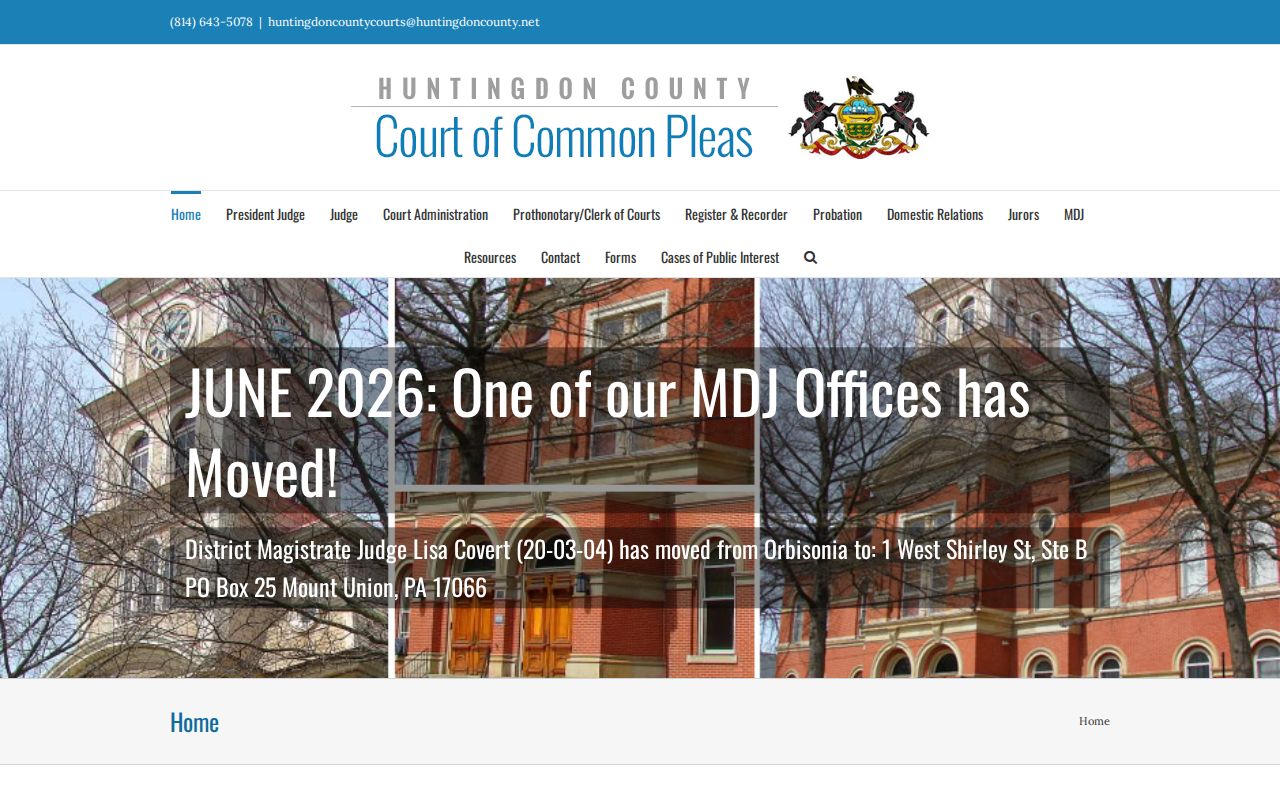
That local source also carries a practical warning: visitors to MDJ facilities must secure phones and other personal electronic devices in their vehicles because public storage is not supplied.
Inside a Huntingdon County Criminal Record
CHRIA defines criminal-history information around identifiable descriptions and dates or notations of arrests, formal charges, and resulting dispositions. A repository cycle may connect aliases, date of birth, fingerprints, an offense tracking number, arresting agency, charges, court identifiers, outcome, and sentence. It excludes intelligence, investigative, and treatment information. A police narrative and a PATCH response are therefore different records.
| Name & Identifiers | Name, aliases, birth data, state identifier, fingerprints, and transaction number where maintained. |
|---|---|
| Arrest / Booking Data | Arrest date, agency, intake date, booking number, custody status, and release or transfer details. |
| Charges & Statutes | Offense text, statute citation, grade, complaint, and later amended counts. |
| Disposition | Outcome for each filed count, including dismissal, withdrawal, plea, acquittal, or conviction. |
| Sentence | Confinement, probation, costs, fines, and other terms shown in the court file. |
| Custody / Supervision | County detention, state incarceration, county probation, or state parole recorded in the proper system. |
An arrest without a disposition can reflect a reporting delay or identity mismatch. Compare the OTN and docket, then use the filing court or PSP correction route with documentary proof.
Huntingdon County Booking Record Fallbacks
Huntingdon County does not publish a verified online jail roster. For current local custody, call the county prison at 814-643-2490. Next, search the UJS portal at the MDJ level for a new complaint. A focused prison records request can seek an identified booking or release record. Use a name, approximate date, arresting agency, and incident, OTN, or docket number when known.
Do not send a local custody question to the state locator. The PA DOC Inmate/Parolee Locator expressly excludes people held in county facilities.
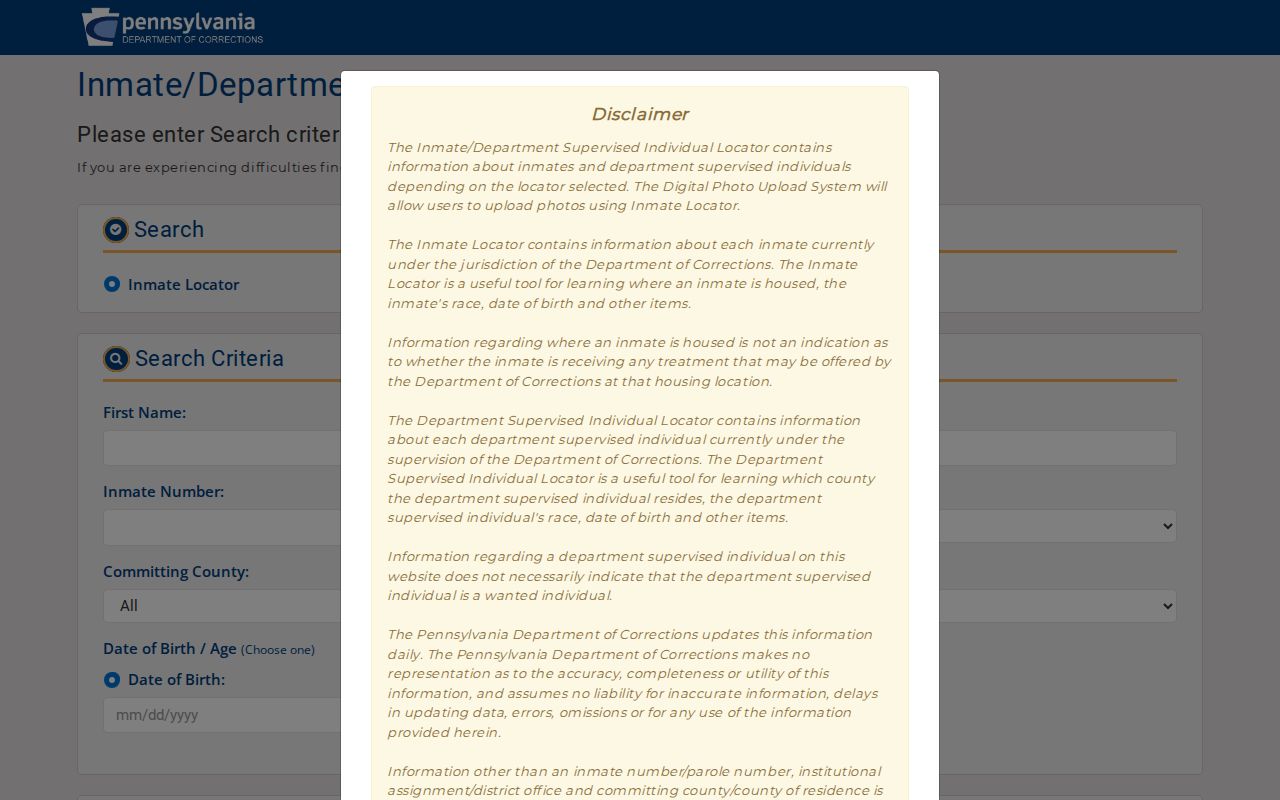
The state tool becomes relevant only after a state commitment or for a state parolee. VINELink may add custody or release notifications, but it does not replace confirmation from the office holding the person.
Note: An arrest is an allegation, and a booking entry does not establish guilt or the final charge.
Public Access Laws in Pennsylvania
Pennsylvania uses different access rules for executive-agency records and court files. A focused request under the Pennsylvania Right-to-Know Law normally draws an agency response within five business days, subject to a lawful extension. Criminal investigative records, juvenile material, victim information, medical or security information, and court-restricted material can be withheld or redacted. Court dockets are governed by judiciary public-access policies, so a county RTKL form is not a substitute for the Clerk's court-record process.
Key Pennsylvania laws:
18 Pa.C.S. Chapter 91 defines and regulates criminal-history collection, release, completeness, and correction.
18 Pa.C.S. § 9121 governs repository regulations and dissemination.
18 Pa.C.S. § 9122 sets statutory expungement paths.
18 Pa.C.S. § 9122.1 covers petitions for orders of limited access.
18 Pa.C.S. § 9122.2 provides Clean Slate limited access.
A useful RTKL request identifies the existing record rather than asking the agency to answer questions. The DA rejects verbal or anonymous requests, requires a name and response address, and lists a $0.25 per-page copy charge.
Three Huntingdon County Custody Records
The county prison, SCI Huntingdon, and SCI Smithfield are three separate institutions in one county. The Church Street prison holds pretrial detainees and county commitments. SCI Huntingdon and SCI Smithfield are PA DOC state prisons. Their presence does not turn state inmates into Huntingdon County arrest statistics or place local booking records in the DOC locator.
The official SCI Huntingdon profile describes Pennsylvania's oldest continuously operating correctional institution.
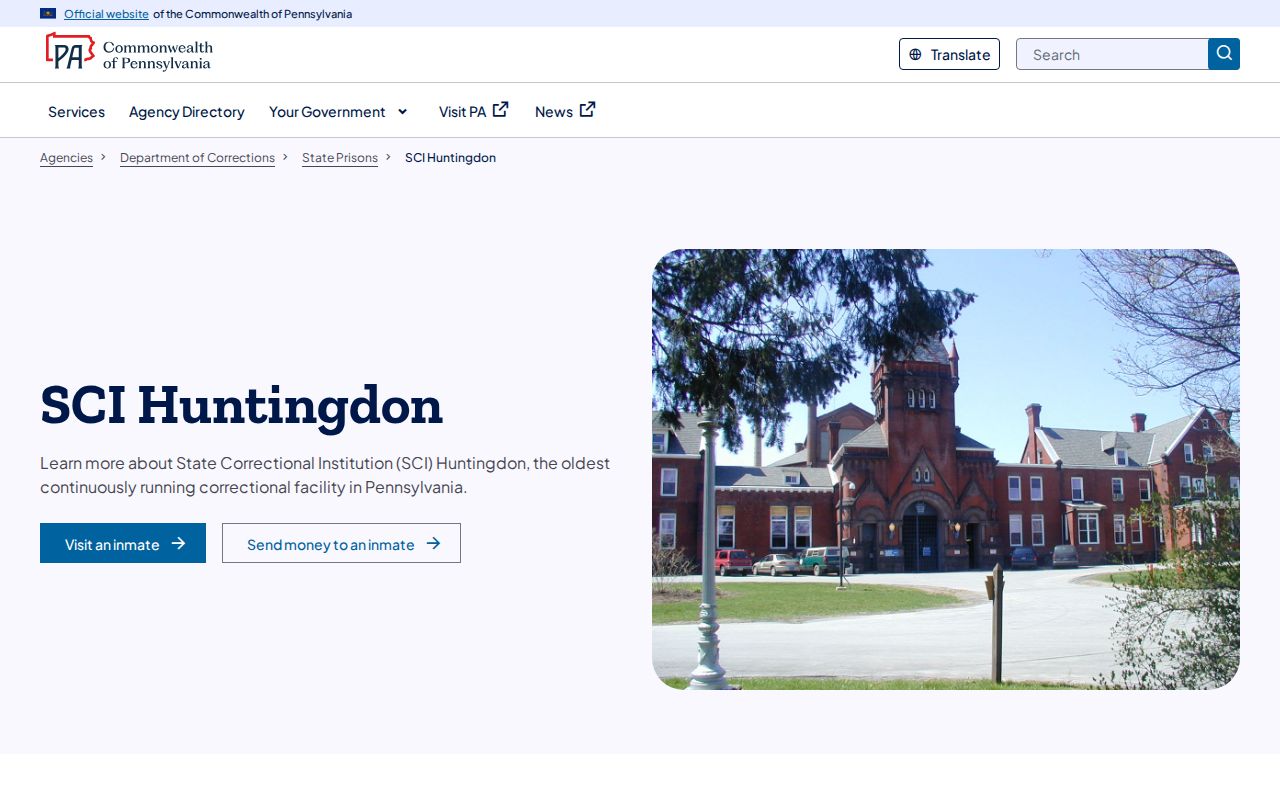
Its history reaches to an 1878 authorizing act and the first reception in 1889. It is a state institution at Pike Street, not the county booking jail.
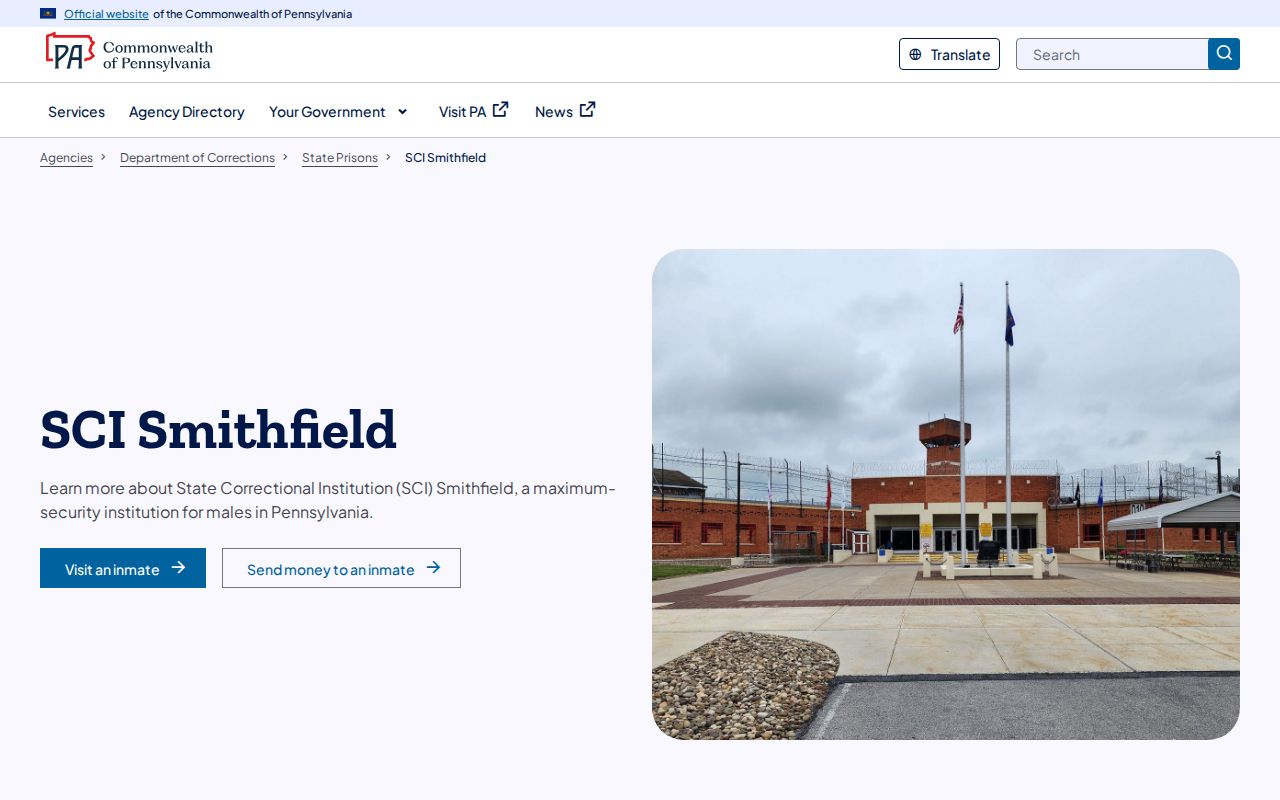
The SCI Smithfield profile confirms the second PA DOC facility in Huntingdon County.
Use the institution and locator named on a state record. For a local detainee, the county prison remains the direct source.
Sealed, Expunged, and Restricted Records
Pennsylvania distinguishes expungement from limited access. Expungement can remove records under defined statutory routes. An order for limited access shields qualifying records from ordinary public view while preserving access for specified criminal-justice and other authorized purposes. Clean Slate adds automated limited access for eligible matters. A pardon may support a later expungement request, but it does not by itself rewrite every agency copy.
The Huntingdon County Clerk of Courts is the local filing office. A petition needs exact docket numbers, so search both the MDJ and CP records first. Eligibility depends on the outcome, offense, time, completion of sentence, and statutory exclusions. No current official source clearly itemized a general Huntingdon County filing fee, so confirm the current packet and cost with the Clerk.
- Expungement
- A statutory process that can remove qualifying criminal-history records.
- Limited access
- A court-ordered shield from ordinary public access, not total destruction.
- Clean Slate
- Automated limited access for records that meet Pennsylvania's requirements.
- Disposition
- The recorded outcome of a charge, such as dismissal, acquittal, plea, or conviction.
After an order, allow time for processing and check UJS and PSP separately. A signed order and exact identifiers help correct a source that still displays restricted material.
Huntingdon County Warrant Record Checks
No complete official public active-warrant database was confirmed for Huntingdon County. Start with the court shown on a known docket. The Clerk can address Common Pleas process at 814-643-3091, while the sheriff can discuss service or surrender logistics at 814-643-0880. A bench warrant may appear as a docket event, but an old entry is not proof that the warrant remains executable.
Identify the issuing court and docket, ask about the current status and bail or surrender process, and obtain written or docket confirmation after resolution. Sealed warrants and juvenile process will not appear in an ordinary public search. Do not use a commercial people-search list as a substitute for the court or sheriff, and do not call 911 just to ask for a name search.
Note: A resolved Huntingdon County warrant may remain in the historical docket even after it is no longer active.
Huntingdon County Criminal Records by City
Pennsylvania calls these incorporated places boroughs. The top three by 2020 Census place population are Huntingdon, Mount Union, and Three Springs. Local police or PSP create the incident report, but district and Common Pleas dockets remain in the countywide UJS system. Each borough route therefore begins with the agency that handled the event, then follows the case to the correct MDJ and Huntingdon County Clerk.
Huntingdon Criminal Records
6,827 residents in 2020. Borough police reports, downtown record counters, and MDJ 20-03-02.
Mount Union Criminal Records
2,308 residents in 2020. Borough police reports and MDJ 20-03-04 on West Shirley Street.
Three Springs Criminal Records
444 residents in 2020. Confirm the police agency, then use county custody and court channels.
Huntingdon County Records Across Eras
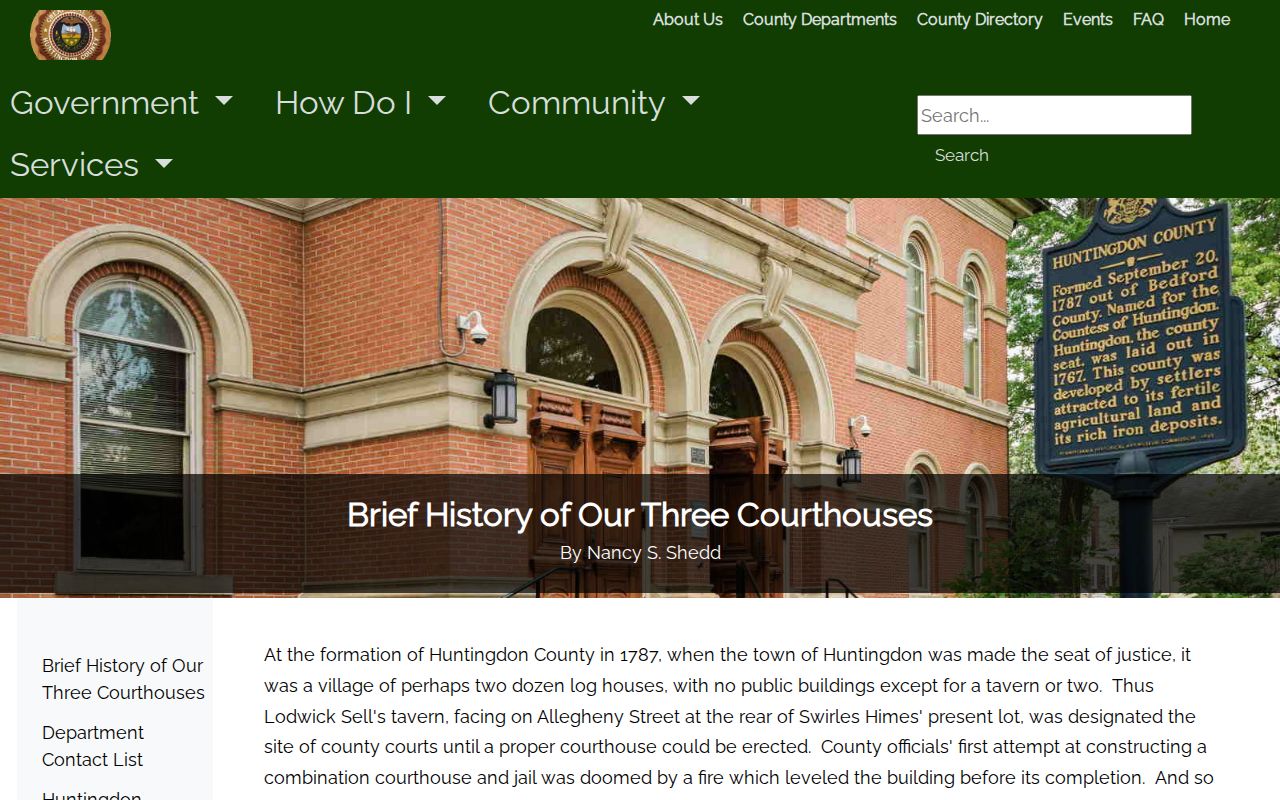
Huntingdon County was formed in 1787, when its seat had about two dozen log houses. Courts first met in Lodwick Sell's tavern. The present courthouse grew from plans presented in 1882, followed by later remodeling, accessibility work, a 1992 fire, and restoration. That long paper history matters to a modern criminal-record search because not every older or non-imaged file is available through UJS.
The county's official three-courthouse history documents how the records building changed over time.
When an index points to a file that cannot be viewed online, the Clerk counter at 223 Penn Street is the authoritative fallback. Staff can address copies and certification, but court staff and chambers cannot give legal advice or discuss a case's merits.